

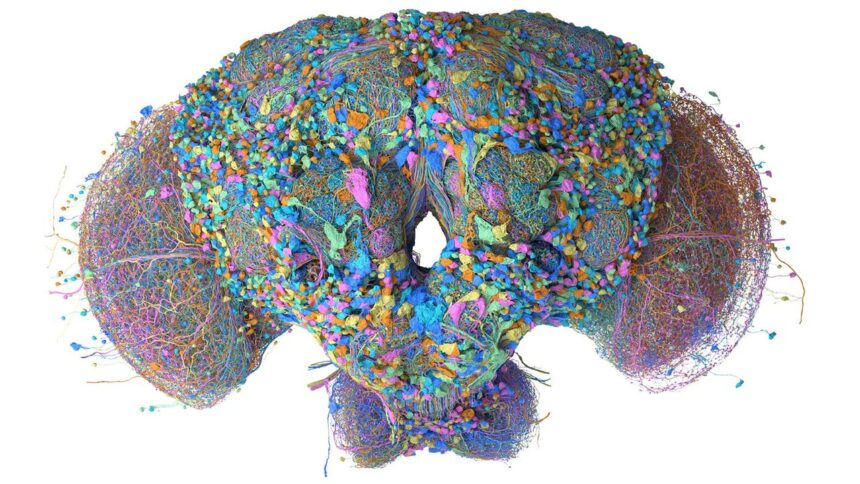
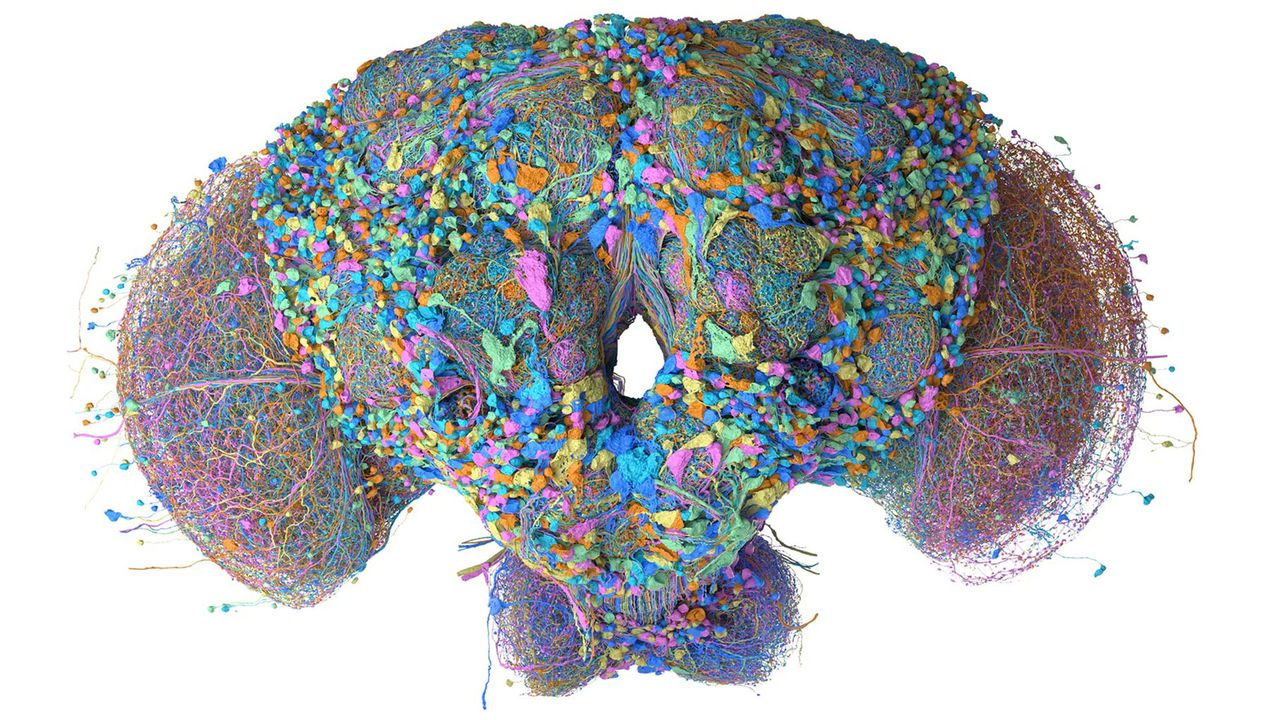
When Google Research and the HHMI Janelia Research Campus announced the completion of MaleCNS v1.0, they delivered a comprehensive anatomical map representing the entire central nervous system of an adult male fruit fly. Reconstructed from millions of high-resolution two-dimensional electron microscopy images using specialized machine learning pipelines, the dataset detail includes 166,700 individual neurons and their intricate synaptic connections. Almost immediately following its release, independent software developers began adapting the raw connectome data into executable environments. By converting biological circuit topographies into interactive computational models, researchers created a functional fruit fly connectome simulation capable of processing external environmental inputs and generating reactive motor outputs in real time.
The transition from a static anatomical repository to an interactive software model underscores a significant shift in how neuroscientific datasets are utilized across the tech industry. Traditionally, structural connectomes served primarily as static reference guides for neuroscience labs studying sensory processing, instinctual behaviors, or genetic mutations in model organisms. Making high-resolution connectomics data publicly accessible allowed software engineers to treat the biological network as an unoptimized neural architecture. Instead of constructing artificial neural networks from mathematical abstractions, developers examined whether biological wiring diagrams could operate as functional controllers within synthetic software environments. Readers can explore related architectural concepts in our analysis on AI hardware standard robotics automation and model integration.
Translating a Fruit Fly Connectome Simulation into Code
To transform a static map of 166,700 neurons into an active control loop, developers established functional interfaces between digital game state parameters and simulated biological cells. In standard machine learning workflows, artificial neural networks process numerical arrays through weight matrices adjusted via backpropagation algorithms. A fruit fly connectome simulation relies on a fixed biological topology where specific neuron clusters handle specialized tasks such as visual processing and motor control.
In one open-source implementation focused on the classic game Doom, software developer Alex Wormuth mapped the incoming video frames directly to the sensory input neurons of the simulated connectome. Each visual frame rendered by the software engine is translated into spatial stimuli that trigger activation patterns across the fruit fly visual assembly. The resulting cascade of signals propagates through the simulated interneurons of the connectome until reaching motor output pathways. These downstream activations are translated into discrete game controls, allowing the simulated nervous system to move the player character through the environment.
Reconstructing 166,700 Neurons with Machine Learning
The structural foundation of this experiment rests on the precision of the MaleCNS v1.0 reconstruction. Creating the original dataset required combining millions of microscopic tissue slices into a continuous three-dimensional volume. Machine learning models developed by Google Research traced individual axonal and dendritic arbors, identifying synaptic junctions across the entire graph. This computational alignment resolved long-standing questions regarding how insect central nervous systems integrate multi-sensory inputs across localized brain regions.
Converting this structural map into an active simulation introduces unavoidable abstractions. While the visual reconstruction identifies physical connections between neurons, it does not inherently capture the full spectrum of chemical neurobiology. Factors such as exact neurotransmitter concentrations, ion channel conductances, and receptor kinetics are absent from static electron microscopy images. Consequently, software developers running these models must make algorithmic assumptions about signal transmission speeds and action potential propagation across the network topology.
Mapping Sensory Inputs to Game Actions
Connecting game state data to biological sensory pathways requires precise architectural mapping. In another community experiment, developer Jessica Paquette built a fly-brain simulation playing Super Mario 64 using software code generated with GPT Astra. Spatial coordinates and optical vectors from the game world stimulate specific visual receptors, forcing the underlying biological network to generate spatial steering decisions.
Observing the behavior of these early simulations highlights the stark contrast between biological instincts and digital goals. When placed into virtual spaces, the simulated connectome frequently exhibits repetitive geometric trajectories, such as steering into obstacles or circling open space. This behavior closely mimics the innate phototactic and thigmotactic responses observed in live insects navigating physical barriers. The simulation does not possess higher-level conceptual understanding of game objectives; rather, it processes optical signals according to hardwired survival instincts.
The Mechanics of Reinforcement in Biological Simulations
A central question surrounding these biological network simulations is whether a static connectome can exhibit functional learning without traditional backpropagation. Artificial reinforcement learning models rely on continuous gradient descent to alter synaptic weights based on defined reward functions. In contrast, biological brains rely on complex neuromodulatory systems that release biochemical signals to alter synaptic efficacy in response to external feedback.
To induce adaptive behavior within the Doom simulation environment, Wormuth integrated a specialized biological reinforcement mechanism. When the player character sustains damage within the game, the software triggers a negative stimulus sent directly to two PPL101 dopamine neurons embedded within the connectome. In the biological fruit fly, PPL101 neurons play a key role in processing aversive feedback, signaling environmental threat to adjacent learning centers.
Dopaminergic Signaling and In-Game Rewards
By stimulating these specific dopaminergic cells during health loss, the simulation attempts to replicate the biological mechanisms that drive avoidance learning. When the PPL101 neurons fire, they modulate signal transmission across surrounding synaptic connections, theoretically discouraging pathways that led to damage. This approach tests whether targeted neuromodulation within a biologically faithful topology can guide behavior toward survival objectives without overwriting core structural architecture.
This biological reinforcement paradigm contrasts sharply with conventional artificial intelligence methodologies. Traditional game-playing models require millions of training iterations across fully connected linear layers to discover basic navigation strategies. A biological connectome arrives pre-structured with evolutionary priors designed for immediate sensory integration and reactive movement. Readers interested in model execution architecture and transparency can examine our analysis on OpenAI Astra monitorability and AI safety.
Synthetic Neuromodulation versus Traditional Backpropagation
The divergence between biological connectomes and artificial neural networks highlights a fundamental trade-off in computational efficiency. Backpropagation requires computing partial derivatives across every layer of a dense network, incurring massive memory overhead during tensor updates. Biological networks utilize localized sparse signaling where action potentials fire asynchronously and updates occur locally through chemical modulation.
Replicating this localized biological signaling in software presents unique computational bottlenecks. Standard graphics processing units are optimized for dense matrix multiplications rather than asynchronous, event-driven neural spiking. Consequently, simulating 166,700 biological neurons along with their localized chemical receptor dynamics requires significant memory bandwidth and specialized simulation frameworks. As developers refine these open-source tools, optimizing compute efficiency remains a major technical obstacle.
Architectural Limits of Static Biological Wiring Diagrams
While the MaleCNS v1.0 dataset represents an extraordinary milestone in structural biology, researchers emphasize that a static wiring diagram provides only part of the biological equation. A connectome maps physical synapses, but living brains are dynamic biochemical systems influenced by neuropeptides, hormonal balances, glial cell interactions, and metabolic constraints. Without accounting for these extra-synaptic interactions, software simulations remain approximations of living neural function.
Furthermore, questions remain regarding the long-term adaptability of a fixed connectome. In physical organisms, learning involves structural plasticity, where new dendritic spines form and unnecessary synapses are pruned over time. Software models that rely solely on static connectome topology are constrained by the structural boundaries established during the initial mapping process. Whether targeted dopamine signaling alone can drive complex goal-oriented adaptation in a static graph remains an active area of empirical investigation.
The Gap Between Synaptic Topology and Dynamic Plasticity
The distinction between structural connectivity and functional dynamics is crucial when evaluating the intelligence of connectome models. Having a map of physical connections does not guarantee an understanding of how those paths are prioritized under varying environmental stressors. In live fruit flies, internal states such as hunger, fatigue, or circadian rhythms dynamically alter how sensory signals route through the brain.
In current software simulations, these internal metabolic variables are largely absent or highly simplified. The game engine feeds static sensory frames into the connectome, and the model evaluates signal propagation through constant synaptic weight parameters. Until software frameworks incorporate dynamic plasticity models that allow structural updates or chemical state decay over time, simulated connectomes will operate primarily as static biological finite-state machines rather than fully autonomous learning entities.
Computational Demands of High-Fidelity Neural Emulation
Running real-time simulations of 166,700 neurons involves substantial compute infrastructure. To calculate the differential equations governing membrane potentials, ionic flux, and synaptic delays across hundreds of thousands of cells, simulation engines must perform billions of calculations per second. In physical organisms, these complex biochemical reactions occur simultaneously with minimal power consumption, operating within fractions of a milliwatt.
Simulating that same biological efficiency on general-purpose computer hardware requires gigabytes of dedicated memory and sustained processor throughput. This stark energy disparity illustrates why neuromorphic computing architectures—chips specifically designed to emulate physical brain structures—are increasingly seen as necessary hardware platforms for future connectome research. General-purpose cloud clusters can run these models for experimental demonstration, but real-time emulation of larger connectomes will require hardware natively aligned with biological mechanics.
The rapid adoption of the MaleCNS v1.0 dataset by software engineers demonstrates the shrinking timeline between foundational scientific discovery and open-source software experimentation. By open-sourcing complete neural maps, institutional research teams provide the broader technology sector with novel structural templates for artificial intelligence research. Rather than relying entirely on synthetic, fully connected layers, future neural network designs may increasingly incorporate sparse, evolutionarily proven subnetworks derived directly from biological connectomes.