

When Apple introduced the iPhone Duo at a starting price of $1,999, it marked a decisive shift in how hardware manufacturers approach flexible screen technology. For years, the foldable smartphone category was defined by early experimental designs, fragile polymer surfaces, and pronounced center creases that diminished the user experience. By entering the market with the iPhone Duo foldable display, Apple is validating the ultra-premium foldable form factor while establishing a distinct technical blueprint for the industry. The decision to enter at a two-thousand-dollar threshold places the hardware squarely against existing flagships from Samsung and Google. This sets up a direct confrontation over display durability, aspect ratio utility, and software integration across the ecosystem.
Aspect ratio choices and the iPhone Duo foldable display
The geometry of a foldable device determines its practical daily utility far more than raw screen diagonal metrics. Early entrants in the foldable category leaned heavily toward square or near-square internal displays when unfolded. While square displays provide ample canvas for side-by-side portrait application windows, they present significant structural drawbacks for media consumption and standard mobile software workflows. Modern video content, encoded primarily in 16:9 or wider cinematic formats, suffers from severe letterboxing on square panels. This leaves vast areas of the expensive panel dark and completely unused. Furthermore, unoptimized smartphone applications frequently stretch awkwardly across square aspect ratios, disrupting user interface hierarchies and touch targets.
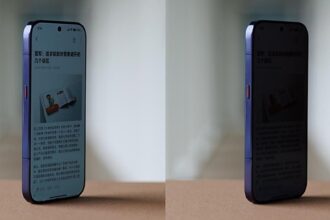
Apple addressed this fundamental design friction by selecting a consistent 1:1.4 aspect ratio for both closed cover and open tablet states. When closed, the iPhone Duo functions as a compact device utilizing a 5.4-inch outer display with asymmetric corner radii. The cover screen features sharp corners along the hinge edge and rounded corners on the outer edge. This visual asymmetry serves an ergonomic purpose by signaling the direction of the mechanical hinge fold to the user. Unfolding the device reveals a 7.6-inch Super Retina XDR internal panel that maintains the exact same 1:1.4 dimensional proportion. Context on physical dimensions and ergonomics is available through foldable iPhone form factor comparisons across existing market alternatives.
By standardizing on a 1:1.4 geometry, Apple provides application developers with a predictable and uniform interface canvas. Software does not need to reconcile radical shifts in proportional relationships when transitioning between closed and open orientations. Video playback occupies a significantly higher percentage of total surface area, mitigating expansive black bars while retaining space for floating playback controls. Furthermore, standard smartphone application layouts scale far more naturally onto a 1:1.4 ratio, eliminating the distorted stretching that commonly plagues square foldable panels.
Engineering the crease: glass, polymer, and titanium
The central engineering challenge of any flexible display remains the visible crease and surface degradation along the primary hinge axis. Flexible organic light-emitting diode panels must bend along tight radii without delaminating, cracking, or developing permanent mechanical fatigue. Early industry solutions relied heavily on soft polyimide films that were prone to scratching and deep centerline grooves over months of repeated mechanical stress. To mitigate these structural liabilities, the internal architecture of the iPhone Duo relies on a multi-layered material stack designed to distribute mechanical tension evenly across the bend radius.
At the foundational layer, a titanium base plate provides rigid structural support across the two main chassis halves while allowing controlled flexion down the center seam. Above the titanium foundation sits a series of ultra-thin flexible glass layers engineered to bend repeatedly without fracturing under tension. These glass layers impart structural stiffness and optical clarity that traditional soft plastics cannot achieve. The top surface layer introduces a specialized custom polymer formulation engineered with elevated surface hardness to resist indentation from fingernails and foreign debris.
This polymer layer features a specialized nano-texture finish designed to scatter ambient light reflections across the screen, according to official iPhone Duo details published by the company. High ambient reflectivity has long plagued foldable screens, as light refracting off the curved crease area emphasizes visual imperfections. The application of a nano-textured surface diffuses point-source light in bright outdoor environments, making the central crease significantly less visible during standard viewing angles. However, multi-layer composite displays face ongoing mechanical risks from thermal expansion, mechanical compression, and delamination over thousands of fold cycles. Real-world environmental exposure over multi-year ownership cycles will ultimately determine the durability bounds of this mechanical stack.
Economic strategy and competition in the premium segment

Apple entering the foldable segment at $1,999 brings structural disruption to a pricing tier previously dominated by Samsung and Google. For several generations, Samsung refined its Galaxy Z Fold series, gradually transitioning from narrow cover screens to wider chassis dimensions with the Galaxy Z Fold 8. The move toward wider aspect ratios across the industry reflects broad consensus that narrow cover screens impede quick interaction, forcing users to unfold the device for basic daily tasks. However, producing foldable panels with flexible glass and titanium underlays involves lower manufacturing yields compared to traditional rigid glass displays. Broader market trends can be examined in rising smartphone costs across the mobile hardware ecosystem.
The $1,999 pricing strategy indicates that high-end foldables are establishing a distinct ultra-luxury category rather than replacing standard flagships. At this price point, the device targets power users and enterprise deployments willing to pay premium prices for multi-window productivity. This high threshold provides manufacturers with the profit margins necessary to absorb complex repair obligations and continuous research costs associated with flexible substrates. Furthermore, Apple reliance on advanced display partners like Samsung Display highlights the complex industrial interdependence of the mobile sector, where primary market competitors simultaneously operate as critical component suppliers.
Software execution and developer interface constraints
Hardware innovation in mobile devices inevitably demands corresponding software adaptations from operating system architects and third-party developers. Operating systems designed for static single-screen rectangles must adapt to handle dynamic surface expansions, multi-window tiling, and rapid layout transitions. In the context of the iPhone Duo, software must gracefully transition active application states from the 5.4-inch outer panel to the 7.6-inch inner display without loss of input focus or visual stutter.
Developer adaptation represents a major variable in the success of the 1:1.4 aspect ratio strategy over competing display formats. While square foldables often require custom multi-pane interface layouts to prevent stretched user interfaces, a 1:1.4 canvas allows standard portrait application layouts to scale naturally while offering predictable side-by-side multitasking capabilities. Operating system window management features can split the 7.6-inch panel into two distinct portrait workspaces that mirror the proportions of standard mobile displays.
However, software scaling across flexible displays introduces non-trivial edge cases that require ongoing optimization. Mobile applications that rely on hardcoded pixel coordinates or rigid asset layout pipelines can experience layout reflow glitches during rapid unfolding operations. Ensuring that complex web views, video players, and high-framerate mobile games transition seamlessly across hinge states requires rigorous optimization within software development kits.
Structural implications for the foldable ecosystem
The arrival of the iPhone Duo signals that flexible display technology has transitioned from speculative experimentation into a mature hardware architecture. As display materials advance and hinge mechanisms grow more compact, the boundary between traditional smartphones and tablets will continue to dissolve. The long-term trajectory for the industry depends on whether manufacturing component yields can eventually decline enough to bring flexible displays into mainstream price points, or if foldables will remain permanently anchored as specialized productivity tools for the ultra-premium segment.