


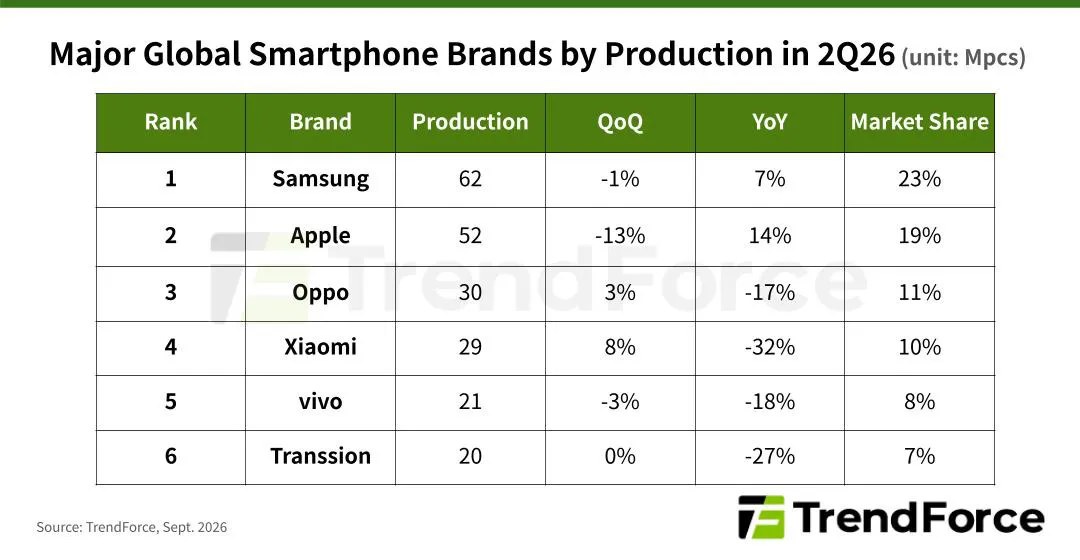
The global mobile hardware landscape experienced a profound structural divergence during the second quarter of 2026 as premium manufacturers widened their lead over budget competitors. Data compiled from global manufacturing monitoring shows that overall global smartphone production contracted by 8 percent year over year to 275 million units across all suppliers. Despite this baseline decline across the sector, Apple produced approximately 52 million iPhone units in Q2 2026, representing a notable 14 percent year-over-year increase. That expansion elevated Apple to a 19 percent share of total worldwide assembly output, proving that premium hardware demand can remain resilient even during broader economic contraction.
Samsung maintained its overall volume leadership across global manufacturing lines by producing 62 million units during the same three-month period. This output reflected a 7 percent year-over-year expansion and consolidated the company’s global output share at 23 percent. Taken together, Apple and Samsung commanded 42 percent of all mobile hardware manufactured worldwide between April and June 2026. The simultaneous growth of these two market leaders highlights an accelerating concentration of industry profits and manufacturing capacity at the upper tier of the product spectrum.
The Strategic Drivers of Global Smartphone Production
The severe contraction in baseline manufacturing hit high-volume, mid-tier vendors across Asian markets with disproportionate impact. Oppo secured the third spot globally with 30 million units produced, but suffered a 17 percent year-over-year decline to capture an 11 percent production share. Xiaomi experienced an even steeper contraction, falling 32 percent year over year to 29 million units and holding a 10 percent share. Vivo produced 21 million units, representing an 18 percent drop for an 8 percent market share, while Transsion fell 27 percent year over year to 20 million units, holding 7 percent of total production output.
These widespread double-digit drops across high-volume Chinese original equipment manufacturers illustrate the extreme vulnerability of hardware vendors heavily exposed to price-sensitive consumer markets. In these regions, persistent inflation and local currency volatility have lengthened replacement cycles far more aggressively than in mature Western markets. Budget and mid-tier device buyers frequently delay hardware upgrades when essential living costs rise, creating immediate demand cliffs for manufacturers that lack high-margin luxury devices to offset volume contractions.
Pricing Strategy and Supply Chain Execution
Apple’s ability to increase assembly output during a widespread market downturn is closely connected to the precise price positioning of its flagship lineup. By holding baseline retail pricing steady across key global markets while delivering tangible hardware upgrades in the iPhone 17 series, the company successfully attracted consumers who were considering mid-tier alternatives. Rather than raising prices in response to input cost pressures, Apple utilized its massive procurement scale to absorb rising component expenses, establishing a competitive value proposition that smaller Android vendors could not match.
This structural cost advantage plays a pivotal role in explaining why rising smartphone costs are reshaping the market and driving industry consolidation. Top-tier manufacturers negotiate long-term component pricing contracts that protect their operating margins, while mid-tier competitors are exposed to spot-market pricing for memory, display panels, and system-on-chip silicon. When component costs rise unexpectedly, smaller brands are forced either to increase retail prices or trim hardware specifications, both of which alienate price-conscious consumers and suppress replacement momentum.
Pull-Forward Demand and Inventory Realignment
Despite Apple’s impressive output metrics, market analysts emphasize that a substantial portion of recent assembly velocity reflects pull-forward purchasing behavior rather than genuine organic market expansion. Consumers aware of incoming hardware price adjustments across the broader technology sector have accelerated their replacement decisions. Anticipated increases in component overhead, particularly regarding advanced memory modules and semiconductor packaging, have created a widespread expectation that future flagship generations will carry elevated retail price tags.
This consumer behavior shift is particularly visible as buyers evaluate the timing of upcoming hardware cycles, including expectations surrounding the iPhone 18 Pro release date and its associated technological changes. When buyers lock in current-generation devices to avoid projected price increases, manufacturing lines experience a temporary surge in order fulfillment. However, this dynamics creates operational risk for original equipment manufacturers, as sales volume pulled forward into current quarters typically leads to reduced demand in subsequent product cycles.
Revised Forecasts and Supply Chain Volatility

The structural dynamics governing total manufacturing capacity are detailed in a recent TrendForce market report analyzing regional assembly outputs. Market intelligence firms have revised their full-year 2026 global production forecasts upward from 1.05 billion units to 1.07 billion units. While an upward adjustment indicates that the overall market contraction is somewhat less severe than initially feared, full-year production is still projected to fall by approximately 14 percent compared to total output recorded in 2025.
This upward revision reflects original equipment manufacturers normalizing their inventory levels after aggressive production cutbacks rather than a fundamental surge in consumer purchasing power. Supply chain channels that had previously drained excess component inventories are now placing baseline reorders to maintain steady channel distribution. Nevertheless, total annual production figures remain depressed, reinforcing the reality that global hardware demand has entered a mature, slow-growth era where market share gains must come at the direct expense of competitors.
Regulatory Constraints and Long-Term Trajectory
In addition to component costs and demand fluctuations, regulatory shifts in major jurisdictions are altering how hardware vendors approach long-term platform profitability. As legal frameworks in Europe and North America challenge traditional app store monetization structures and default software pre-installations, gross hardware margins become a crucial buffer for corporate revenue. Premium brands capable of generating consistent ecosystem services revenue across an affluent installed base can afford to price hardware aggressively to gain share, a strategic flexibility denied to low-margin budget manufacturers.
The stark polarization observed across second-quarter production metrics points toward a permanent restructuring of the global mobile device sector. Scale, ecosystem integration, and supply chain leverage have become indispensable requirements for surviving persistent macroeconomic drag. As elevated component prices and shifting economic conditions test consumer patience in future product generations, hardware manufacturers will no longer be able to count on pulled-forward demand to sustain assembly line volume. The coming quarters will clarify whether premium hardware resilience can endure deeper macroeconomic headwinds or if the broader market must adapt to a lower, highly consolidated baseline.