

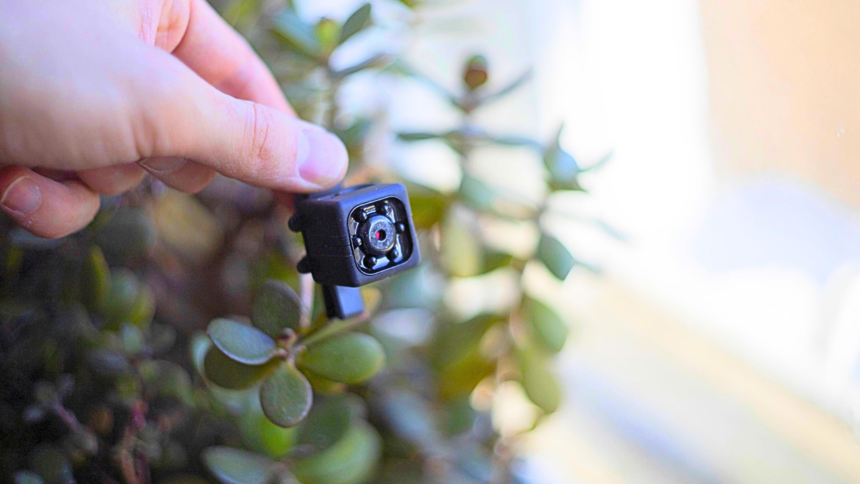
The proliferation of covert surveillance hardware in hospitality settings, public facilities, and rental properties has turned personal space protection into a technical challenge. Traditional optical scanners and radio frequency detectors often require specialized knowledge, expensive equipment, or tedious manual sweeps. To address this friction, academic engineers have developed an accessible hardware-software countermeasure designed to detect hidden cameras using consumer smartphones. A joint research collaboration between the Korea Advanced Institute of Science and Technology, the National University of Singapore, and Singapore Management University produced SweepLED. Led by Professor Han Jun from KAIST, the team combined a cheap magnetic light module with edge artificial intelligence. The resulting clip-on device enables mobile devices to scan complex physical environments with high accuracy, establishing a new benchmark for low-cost privacy verification tools.
The fundamental flaw of manual camera detection lies in human visual limitations and unpredictable environmental lighting. During traditional physical sweeps, individuals shine a white light source around a room while watching for tiny specular flashes. This manual technique relies entirely on human vision, which degrades rapidly under visual fatigue and produces frequent errors when encountering shiny screws, plastic trim, or metallic watch faces. Alternatively, standalone mobile applications that analyze static camera frames struggle with background noise because stationary glints mirror the optical reflection of actual glass lenses. Without precise directional control over light sources, software cannot distinguish between harmless ambient reflections and true camera optics.
Understanding Optical Physics to Detect Hidden Cameras
SweepLED resolves this detection ambiguity by introducing dynamic light modulation through a synchronized hardware and software loop. The physical accessory consists of a compact light-emitting diode matrix costing roughly seven dollars, or approximately ten thousand South Korean won. The module attaches magnetically to the back of a standard smartphone near its main camera sensor, drawing minimal power while operating. Rather than emitting static illumination, the grid systematically alters light angles and flash intensity in rapid, continuous patterns. As these shifting beams illuminate target surfaces, the interaction generates distinct reflection signatures that vary continuously based on the underlying geometry of the reflecting surface.
Optical lens assemblies possess structural characteristics that separate them from ordinary reflective materials. When light enters a miniaturized camera assembly, it strikes curved lens elements, passes through an aperture diaphragm, and reflects off the internal image sensor. This specific optical path triggers retroreflection, a phenomenon where incident light rays bounce directly back along their original vector rather than scattering randomly across surrounding space. According to research findings reported by The Chosun Daily , the SweepLED software captures a high-frame-rate video feed of these localized light responses, feeding the dynamic visual data directly into a specialized computer vision algorithm.
The machine learning model evaluates how reflections shift, dim, or disappear in response to controlled light movement. By analyzing these multi-frame optical dynamics, the application isolates the unique retroreflective signature of hidden lenses while filtering out static background glint. In real-world testing across thirty distinct physical test objects, including various household items embedded with concealed pinhole cameras, the system achieved a 93.9 percent detection accuracy rate. This dynamic algorithmic approach eliminates human subjective guesswork while dramatically reducing false positives, offering an automated scanning process that completes within seconds.
To appreciate the broader implications of micro-hardware privacy tools, one must examine how edge computing transforms personal physical security. Processing high-resolution video streams locally on smartphone hardware eliminates the latency and privacy risks associated with cloud processing. Because the neural network operates entirely on-device, sensitive video footage of private hotel rooms or residential interiors never leaves the user’s phone. This architectural decision balances real-time performance with strict data isolation, ensuring that the tool used to discover covert surveillance does not accidentally create a new network data vulnerability.
Technical Constraints and the Limits of Active Optical Scanning
Despite high detection rates in controlled tests, active optical scanners face fundamental physical constraints that prevent complete reliance on light-based sweeping. Dynamic LED grids rely entirely on optical retroreflection, meaning they can only identify physical lens assemblies exposed to direct illumination. Consequently, light-based detection tools cannot identify non-optical surveillance vectors, including hidden audio microphones, un-lensed magnetic sensors, or network-level data taps. Furthermore, cameras concealed behind specialized semi-reflective glass or one-way mirrors may damp incoming light rays, preventing sufficient retroreflection from returning to the mobile sensor.
Another operational boundary stems from line-of-sight requirements and physical scanning proximity. An active optical clip-on operates as a localized verification tool, requiring users to point their smartphone directly at potential concealment sites from an effective scanning distance. This localized interaction model cannot neutralize ambient recording threats operating outside line of sight. For instance, the proliferation of commercial wearable video hardware presents persistent privacy challenges that static surface sweeps cannot detect. Examining whether smart glasses detector apps can mitigate ambient surveillance highlights how software defenses must constantly evolve alongside mobile hardware form factors.
These line-of-sight limits also intersect with broader platform security paradigms and device trust models. When hardware accessories depend heavily on mobile operating systems for sensor capture and algorithmic processing, the integrity of the underlying operating system becomes paramount. Users must trust that system permissions, camera pipelines, and background processes remain uncompromised during sensitive physical sweeps. Platform design choices play a central role here, much like analyzing whether Apple remains a default privacy choice for users seeking robust sandboxing and hardware-level encryption across personal computing ecosystems.
Furthermore, the rapid evolution of miniature optical components threatens to alter retroreflective profiles over time. As lens manufacturers develop ultra-thin flat optics, meta-surface lenses, and non-reflective antireflective coatings, traditional optical signatures may become fainter or more diffuse. To maintain detection accuracy, machine learning models will require continuous retraining on emerging lens geometries and optical materials. Without ongoing algorithmic updates, hardware clip-ons risk falling behind as covert camera designs adapt to bypass standard retroreflection filters.
Socioeconomic Context and Future Privacy Trajectories
The development of accessible counter-surveillance technology responds to mounting public concern over invasive covert recording. Widespread public outrage against hidden camera voyeurism reached a defining peak in South Korea during widespread national protests in 2018, driving legal reforms and research funding toward anti-surveillance innovation. That regional momentum has since expanded globally as short-term rental guests and hotel patrons express growing anxiety over unmonitored recording devices. Major hospitality platforms have responded by banning all indoor security devices, yet physical policy rules remain difficult to enforce without accessible verification tools.
Lowering the production cost of professional-grade counter-surveillance hardware to approximately seven dollars represents a significant structural shift in physical security access. Historically, effective optical lens detectors were restricted to law enforcement, corporate security teams, and specialized technical personnel due to high hardware costs. By pairing low-cost LED matrices with existing consumer smartphone hardware, academic researchers have demonstrated that sophisticated optical verification can be democratized. This approach shifts the burden of physical security enforcement from centralized property managers directly to individual consumers.
The convergence of low-cost micro-hardware, active illumination, and localized machine learning signals a durable paradigm shift in personal privacy defenses. As miniaturized surveillance components grow cheaper and more pervasive across consumer markets, static physical perimeters alone can no longer guarantee personal privacy. The future of physical security relies on adaptive edge-computing accessories capable of actively probing physical surroundings in real time. Continued research into dynamic optical sensing will determine whether consumer countermeasures can outpace the silent proliferation of covert recording technologies.