
The accumulation of mechanical debris in low Earth orbit poses a continuous structural hazard to operational satellites, orbital stations, and scientific missions. To withstand high-speed orbital collisions, vehicle structures rely on dedicated protective barriers designed to dissipate immense amounts of mechanical impact energy within microsecond timeframes. Traditional physical defenses have reached a technological plateau where adding baseline structural thickness yields diminishing safety returns while introducing severe launch weight penalties. Advancing modern spacecraft shielding requires engineers to combine novel geometrical architectures with dynamic fluid energy absorption mechanisms rather than relying solely on monolithic metallic plates or passive fiber bumpers.
For decades, standard orbital armor has relied almost exclusively on variations of the classic Whipple shield design. First developed to guard against micrometeoroid strikes, a conventional Whipple shield uses a thin metallic outer plate separated by an open gap from the main vehicle pressure hull. Upon collision, the sacrificial bumper shatters or vaporizes the incoming projectile into an expanding cloud of small, lower-density fragments. This expanding debris plume distributes kinetic impact energy over a much wider surface area on the inner hull wall, drastically decreasing puncture risks. Advanced variants frequently incorporate internal layers of Kevlar or Nextel aramid fabric to absorb residual shockwaves without adding excessive structural bulk.
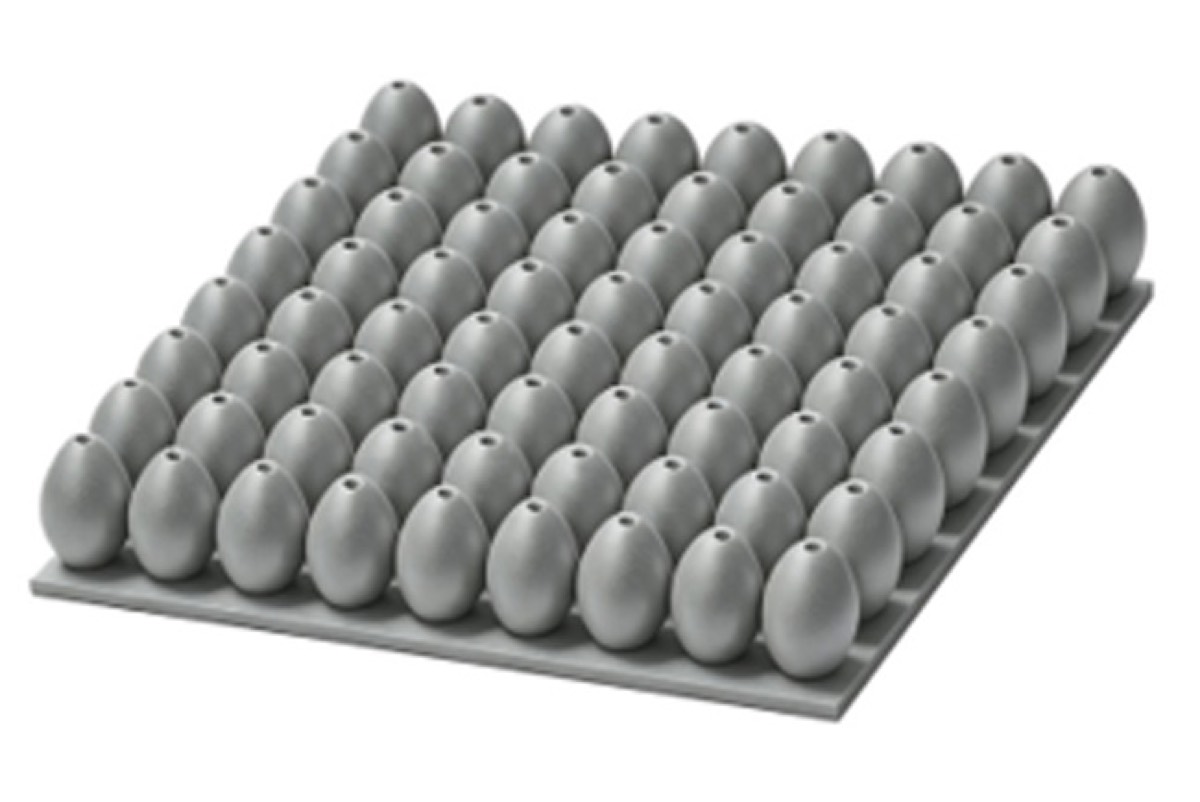
Despite these evolutionary material refinements, severe point-source strikes can still exceed the mechanical tolerances of rigid solid armor. To overcome these material limitations, engineering researchers led by Yuxin Wang at Dalian University of Technology examined biological load-distribution structures for new design models. Avian eggshells demonstrate remarkable mechanical efficiency, using natural thin-walled curved geometries to distribute external compressive loads uniformly across their entire surface. By translating this biological stress-distribution behavior into synthetic metallic arrays, researchers built a structural core capable of converting concentrated kinetic strikes into managed structural deformation.
Evaluating Bio-Inspired Spacecraft Shielding Architectures
To test the viability of biological geometries in extreme environments, researchers fabricated three distinct shield configurations using additive aluminum manufacturing processes. They constructed flat dual-plate aluminum baselines, water-filled aluminum sphere arrays, and water-filled eggshell structures mounted between parallel outer metal plates. The team subjected these test specimens to hypervelocity impact simulations and light-gas gun testing designed to match orbital debris collision dynamics. As documented in the official research release, the geometrical arrangement of internal metastructures alters how localized impact forces spread across adjacent damping units.
The comparative laboratory testing demonstrated substantial performance differences across the evaluated structural designs. Standard dual-plate aluminum structures reduced incoming projectile velocity by roughly 51 percent during hypervelocity impact tests. The water-filled eggshell array achieved a superior 65 percent reduction in projectile speed under identical kinetic conditions. Spatial orientation also played a decisive role in mechanical performance, as placing eggshells upright with narrow tips contacting the sacrificial front plate provided the highest level of structural resistance and kinetic energy dissipation.
This significant jump in protection relies on microsecond fluid-structure interaction during impact events. When a hypervelocity projectile strikes the sacrificial outer bumper, kinetic energy compresses the thin aluminum eggshell walls. Instead of transferring a destructive shockwave directly into the main spacecraft hull, internal fluid sloshes rapidly within the sealed metallic chamber. This violent hydrodynamic sloshing converts kinetic impact shock into complex liquid turbulent motion, spreading mechanical stress across the broader metastructure and suppressing destructive shockwave propagation.
Fluid Damping and Structural Engineering Constraints
Deploying liquid-filled metastructures marks a fundamental departure from conventional solid-state kinetic armor systems. Traditional kinetic barriers depend entirely on permanent plastic deformation, material strain hardening, or sacrificial fragmentation to absorb kinetic energy. Combining internal fluid cavities with metallic shell geometries creates a dynamic viscoelastic response that actively dampens shockwaves during hypervelocity impacts. Integrating complex structural payloads into modern launch architectures also links to broader commercial rocket deployment strategies that balance structural safety margins against strict vehicle payload constraints.
Additive manufacturing serves as an indispensable enabling technology for producing these intricate fluid-filled metastructure arrays. Conventional computer numerical control machining or investment casting cannot manufacture hollow metallic eggshell arrays with controlled wall thickness and internal liquid channels. Precision laser powder bed fusion allows engineers to regulate structural curvature and internal chamber volumes precisely. This manufacturing accuracy guarantees that individual metastructure cells deform cooperatively during high-velocity impacts rather than suffering isolated structural failure.
Thermal Vulnerabilities and Launch Mass Trade-Offs
While laboratory light-gas gun experiments confirm notable energy absorption improvements, applying fluid-filled metastructures to operational spacecraft introduces severe orbital engineering challenges. Orbital hardware in low Earth orbit experiences broad temperature extremes, fluctuating between intense solar heating above 100 degrees Celsius and deep shadow drops below minus 100 degrees Celsius. Pure unconditioned water cannot survive these operational conditions, as freezing would rupture thin metal container walls and unpressurized boiling would destroy essential fluid sloshing dynamics.
To maintain operational integrity across orbital temperature ranges, aerospace engineers must test alternative liquid formulations or chemical additives. Low-viscosity silicone fluids, non-volatile synthetic oils, or tailored glycol compounds could prevent phase changes while preserving necessary fluid density for shock dissipation. However, altering internal liquid viscosity changes shockwave speed through the fluid, requiring meticulous geometric recalibration of internal chambers to maintain maximum energy mitigation performance.
Structural mass trade-offs represent another critical engineering constraint for modern satellite mission architects. Liquid volume adds substantial overall mass compared to ultra-light aramid fabrics or open aluminum honeycomb cores. Because orbital launch costs remain tightly tied to total payload mass, any alternative shielding concept must prove its superior kinetic protection justifies the additional launch mass. Managing these heavy physical payloads directly impacts space economics, especially when navigating current commercial launch bottlenecks and vehicle manifest limits.
Beyond orbital thermal management, fluid metastructures must survive intense mechanical stresses during launch vehicle ascent. Rocket launches subject internal payloads to severe acoustic vibration, steady axial acceleration, and multidirectional gravitational loads. Liquid contained inside thin aluminum cells will slosh during powered flight, generating dynamic internal forces that could fatigue printed metallic joints over time. Moving bio-inspired fluid arrays from laboratory gas-gun facilities to operational space flight requires rigorous vacuum testing, multi-angle impact qualification, and long-term fluid containment validation. The evolution toward liquid-filled metastructures represents a decisive shift from passive single-material armor toward dynamic multi-phase protection systems designed for sustainable orbital operations.