
Navigating the gravitational energy well of the inner solar system presents orbital dynamics challenges that surpass almost any other planetary destination. The recent detachment of the primary drive module on the BepiColombo Mercury mission marks the formal completion of its long cruising phase, setting the stage for gravitational capture around the innermost planet. Led by the European Space Agency in partnership with Japan and supported by contributions from the United States, this two-billion-dollar initiative spent eight years executing a complex trajectory design across billions of kilometers. By jettisoning its dedicated transfer hardware, the spacecraft transitions from continuous low-thrust propulsion to ballistic insertion, opening a crucial window for planetary science and operational validation.
Understanding why reaching Mercury demands such extraordinary energy requires examining the mechanics of solar gravity wells. When a spacecraft travels from the outer solar system toward the Sun, it continuously converts potential energy into kinetic energy, accelerating at an increasing rate as it descends deeper into the gravitational field. Counterintuitively, flying past an outer target requires significantly less velocity change than dropping into a stable orbit around Mercury. A mission heading outward primarily needs enough initial thrust to escape Earth and coast, whereas a probe heading inward must continuously brake against intense solar pull to avoid whipping past its target at unrecoverable speeds. This braking requirement creates a massive velocity budget that traditional chemical fuel tanks cannot realistically support without ballooning launch mass beyond sensible limits.
To solve this massive energy imbalance, space agencies developed an architecture reliant on electric plasma propulsion combined with multiple planetary flybys. The spacecraft launched in 2018 equipped with four gridded ion thrusters mounted on a specialized transit structure. Unlike chemical engines that deliver short, explosive bursts of force with low specific impulse, these electric ion engines accelerate charged xenon particles using electrostatic grids, delivering ultra-high exhaust velocities over thousands of hours. While the force produced by an individual thruster is modest, its continuous accumulation over several years alters spacecraft velocity by tens of thousands of kilometers per hour. Integrating these systems alongside evolving commercial launch capacity constraints allowed mission engineers to minimize the total propellant mass required at liftoff.
Orbital Mechanics and the BepiColombo Mercury Mission Path
Plasma propulsion alone cannot shed all the excess kinetic energy required for orbital insertion. The structural trajectory design relied heavily on nine carefully calculated planetary gravity assists across the inner solar system. By conducting one flyby of Earth, two of Venus, and six of Mercury itself, the flight dynamics team systematically dumped excess orbital momentum back into the host planets. During each flyby, the spacecraft passed through a precise gravitational window, using planetary gravity to bend its orbital shape around the Sun and reduce its relative speed. These repeated encounters served as natural brakes, slowly sculpting a wide heliocentric orbit into a path that closely mirrors Mercury’s fast movement around the Sun.
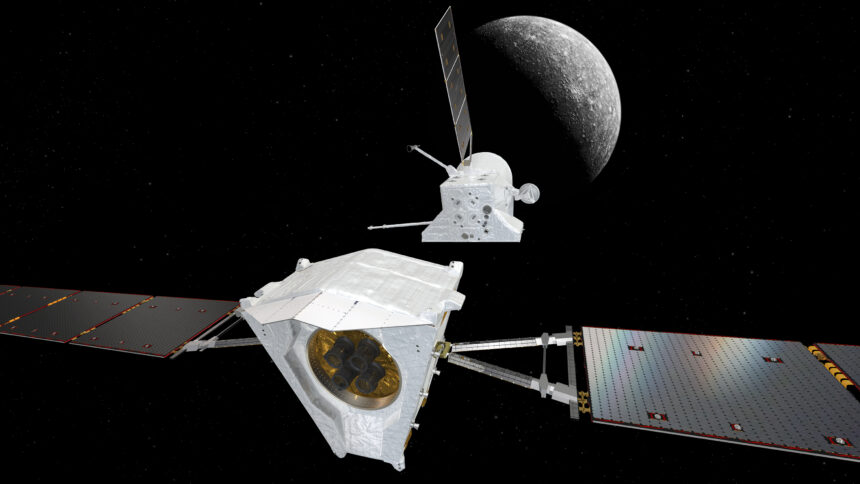
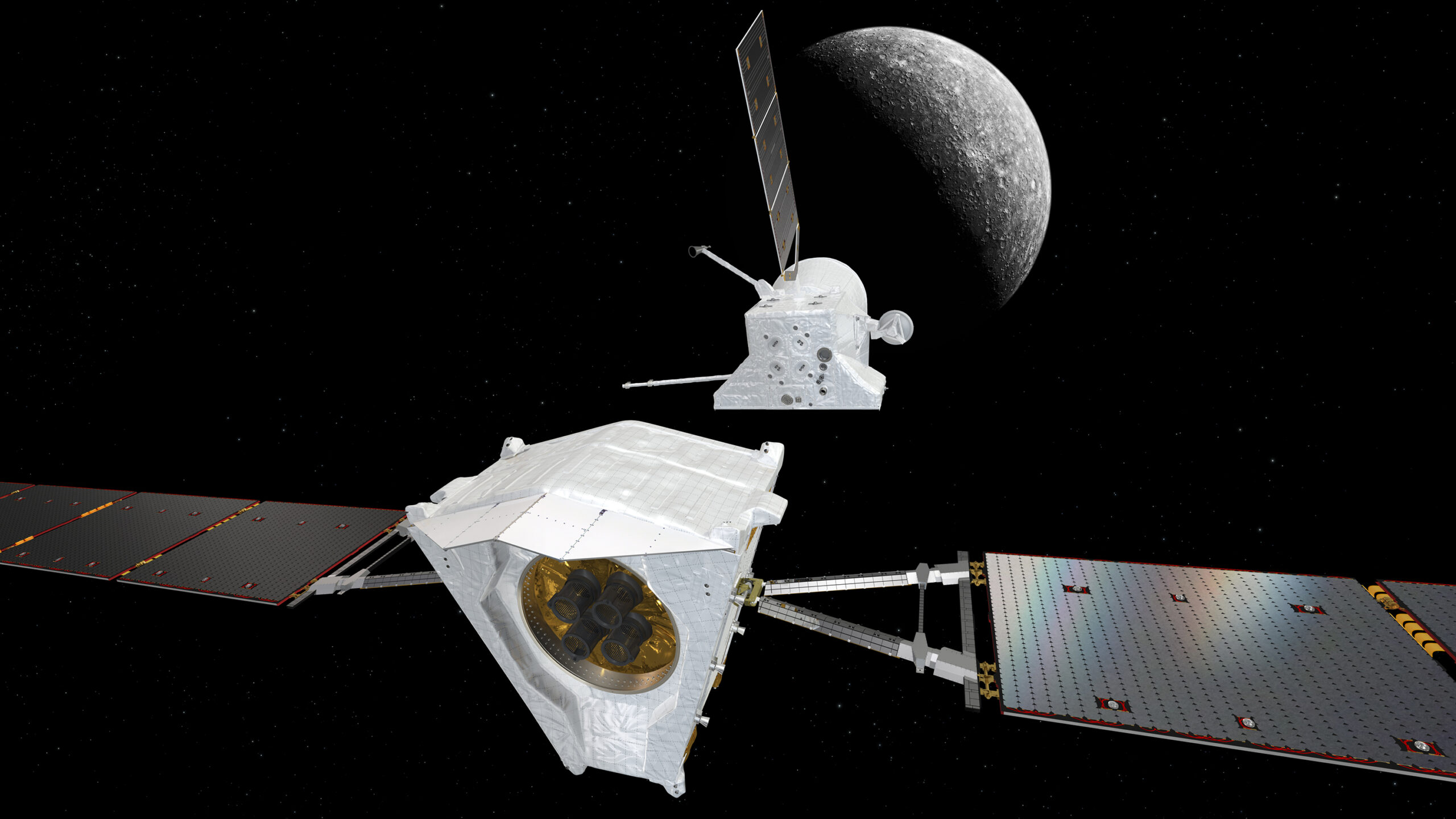
The physical module responsible for powering this multi-year journey was the Mercury Transfer Module. Operating as a heavy-duty engine bus, this component carried the solar arrays, thermal control radiators, and high-voltage power processing units required to run the ion thrusters. Operating close to the Sun created severe thermal constraints, requiring specialized solar array cooling techniques and thermal shielding to protect delicate onboard electronics from intense solar radiation and thermal reflection from Mercury itself. Balancing power generation with thermal load management represented one of the most complex engineering trade-offs of the cruise phase, as the solar panels had to be tilted away from the Sun to avoid overheating while still absorbing enough light to drive the ion thrusters.
Structural Staging and the Transition to Orbital Capture
With the primary ion propulsion maneuvers complete, the spacecraft reached a milestone by jettisoning the Mercury Transfer Module. In deep-space operations, jettisoning a major structural component is an irreversible step that fundamentally alters spacecraft dynamics. By releasing the heavy propulsion unit, the mission drops dead weight that is no longer useful, dramatically reducing the overall mass that must be captured by Mercury’s gravity field. Following separation, the remaining spacecraft relies on reaction wheels and small chemical attitude control thrusters for fine positioning. According to the official ESA mission documentation, shedding this parasitic mass ensures that the gravitational attraction of Mercury will naturally pull the probe into orbit during its upcoming close approach later this year.
The remaining flight stack consists of two independent scientific observatories mated together: the European Space Agency’s Mercury Planetary Orbiter and Japan’s Mercury Magnetospheric Orbiter, officially named Mio. Once orbital insertion is confirmed, these two craft will decouple and separate into distinct orbits to perform complementary scientific missions. The European orbiter will occupy a lower polar orbit focused on mapping surface topography, measuring elemental composition, and probing the internal structural density of the planet. Meanwhile, the Japanese orbiter will take an elliptical outer orbit designed to analyze Mercury’s magnetic field, solar wind interactions, and exospheric environment. Analyzing how environmental factors disrupt orbital infrastructure aligns with broader research into how volcanic climate shocks test global logistics, demonstrating how external systemic stresses test resilient operational design across Earth and space applications.
The structural complexity of multi-agency ventures highlights both the benefits and trade-offs of modern international space exploration. Sharing financial burdens and technical expertise across Europe, Japan, and the United States made a mission of this magnitude feasible within constrained institutional budgets. However, integrating hardware built across different continental engineering standards required painstaking interface testing and operational synchronization. The success of the cruise phase demonstrates that complex, multi-national deep-space architectures can survive nearly a decade in hostile radiation environments without catastrophic component failure, establishing a structural blueprint for future long-duration missions to challenging targets across the solar system.
The removal of the transfer module transitions the spacecraft into its final, unpowered ballistic approach. As the spacecraft approaches its target later this year, the intersection of precise orbital matching and natural gravitational capture will determine the mission’s ultimate scientific yield. Beyond expanding knowledge of planetary formation near host stars, the mission provides concrete operational data on the durability of electric propulsion, low-thrust navigation, and multi-stage spacecraft design. The success of this final trajectory phase will validate electric propulsion as a standard capability for high-energy orbital insertions across the solar system.